Planning application fees in England are changing, with the Government proposing a new National Default Fee Schedule designed to bring planning fees closer to the actual cost of processing applications. But what does this mean if you are planning a house extension, loft conversion or other alteration to your home?
At Design & Development Associates, we regularly help homeowners navigate the planning process. We have therefore looked at the Government’s latest proposals and what they could mean for the cost of obtaining planning permission.
There is also another cost that homeowners need to be aware of: the Planning Portal service charge. When the two costs are combined, the total amount paid when submitting a typical householder planning application is higher than the headline planning fee advertised by the Government.
How much does a householder planning application cost?
For a typical householder planning application in England, the statutory planning application fee from 1 April 2026 is £548.
The Government is proposing to increase the National Default Fee for a standard householder application to £575.
However, there is an additional charge when submitting an application online through the Planning Portal.
The Planning Portal currently applies a £75.83 + VAT service charge, which equates to £91 including VAT, for planning applications attracting a fee of more than £100. This is payable when the application is submitted online.
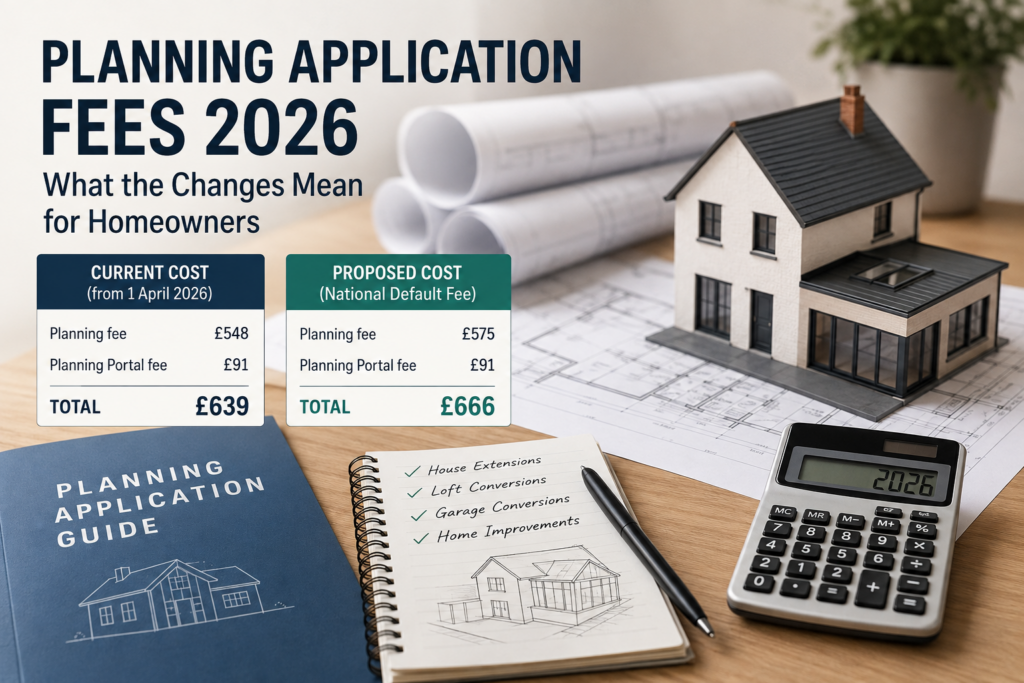
This means the actual amount a homeowner pays when submitting a standard householder application is currently:
| Cost | Current amount |
|---|---|
| Householder planning application fee | £548 |
| Planning Portal service charge | £91 |
| Total payable | £639 |
Under the Government’s proposed National Default Fee of £575:
| Cost | Proposed amount |
| Householder planning application fee | £575 |
| Planning Portal service charge | £91* |
| Indicative total | £666 |
*Assuming the Planning Portal service charge remains £91 including VAT.
It is important to understand that the £91 Planning Portal charge is separate from the planning application fee. The £548 or £575 is the statutory planning fee associated with the application, while the £91 is a service charge for submitting and processing the online payment through the Planning Portal.
The proposed £27 increase is only part of the story
At first glance, the Government’s proposed increase from £548 to £575 looks relatively small.
The increase is:
£575 − £548 = £27
This represents an increase of approximately 4.9% compared with the current £548 fee.
However, once the Planning Portal service charge is taken into account, the total cost of submitting a typical application increases from approximately £639 to £666, assuming the £91 service charge remains unchanged.
For most homeowners, an additional £27 is relatively small compared with the overall cost of an extension or other building project.
Nevertheless, it is useful to understand the true cost of submitting a planning application, rather than looking only at the statutory planning fee.
What is a householder planning application?
A householder planning application is generally used where development is proposed to an existing dwellinghouse.
This can include projects such as:
- Single-storey rear extensions
- Two-storey extensions
- Side extensions
- Wraparound extensions
- Loft conversions requiring planning permission
- Garage conversions
- Changes to the external appearance of a house
- Other alterations to an existing dwelling
The planning application fee is paid in connection with the application to the local planning authority.
The Planning Portal service charge is a separate cost associated with submitting the application online.
Professional fees for architectural design, planning drawings and other supporting information are also separate.
What is the Planning Portal fee?
The Planning Portal is the online system commonly used to submit planning applications in England.
For applications attracting a fee of more than £100, the Planning Portal currently charges a £75.83 + VAT service charge, equivalent to £91 including VAT.
This means homeowners should not simply budget for the council’s planning fee when calculating the cost of submitting their application.
For example, if you are submitting a standard householder planning application at the current £548 statutory fee, your online submission cost is approximately:
£548 planning fee + £91 Planning Portal charge = £639
The £91 charge is therefore an important additional cost to factor into your planning budget.
Could planning fees vary between councils?
Potentially, yes.
One of the more significant aspects of the Government’s proposed reforms is the introduction of a National Default Fee Schedule, alongside greater flexibility for local planning authorities to vary their fees.
The Government proposes allowing local planning authorities to set fees at up to 30% above the National Default Fee, where they can demonstrate that their costs justify the increase.
This could mean that planning fees become less consistent between different areas of England.
For example, using the proposed £575 National Default Fee, a 30% increase would produce a fee of approximately:
£575 × 1.30 = £747.50
Rounded, that is approximately £748.
This does not mean that every council will charge £748. It would be a potential upper level within the proposed local fee-setting framework, subject to the relevant requirements.
If a council were to charge the full 30% variation, and the £91 Planning Portal service charge remained unchanged, the homeowner’s total online submission cost could theoretically be around £839.
This is why the longer-term implications of the reforms could be more significant than the initial £27 increase.
Why are planning application fees increasing?
The Government’s argument is that planning application fees currently do not recover the full cost incurred by local planning authorities when processing applications.
The proposed changes are intended to help councils recover more of the cost of operating their planning services.
The Government estimates that the planning system currently has a significant funding shortfall.
The principle behind the reform is therefore that higher application fees could provide planning authorities with additional resources to employ staff, process applications and improve the service provided to applicants.
For homeowners, the key question will be whether increased fees ultimately result in better and more efficient planning services.
Will higher fees mean faster planning decisions?
Not necessarily.
Although the Government’s proposals are intended to improve the resourcing of local planning departments, paying a higher application fee does not guarantee that an individual application will be determined more quickly.
The quality and completeness of an application remain important.
A well-designed application containing the necessary drawings and information can help reduce avoidable delays, whereas an application that requires significant clarification or amendments can create additional correspondence and delay.
This is one reason why obtaining professional advice before submitting a planning application can be valuable.
What does this mean for the cost of a house extension?
The planning application fee is only one part of the cost of an extension project.
A typical homeowner may need to budget for:
- Architectural design and drawings
- Planning application fee
- Planning Portal service charge
- Planning statements or supporting documents where required
- Structural engineering
- Building Regulations approval
- Specialist surveys where necessary
- Construction costs
- Potential ecology, drainage or other technical reports
Consequently, the proposed £27 increase should be viewed in the context of the overall project.
For a project costing tens of thousands of pounds, the difference between a £548 and £575 planning fee is relatively small.
The more important consideration is ensuring that the correct planning route is selected and that the proposal is designed appropriately from the outset.
Planning fees are separate from architectural fees
It is important to distinguish between the different costs involved in obtaining planning permission.
Planning application fee: paid in connection with the application to the local planning authority.
Planning Portal service charge: currently £91 including VAT for online planning applications attracting a fee over £100.
Architectural or design fees: paid to the professional preparing your drawings and application.
These are three separate costs.
At Design & Development Associates, our role is to help homeowners develop a proposal that responds to their property, planning policy and practical requirements, and then prepare the necessary drawings and planning information.
What about permitted development?
Not every extension requires a full planning application.
Some home improvements may fall within permitted development rights, meaning that planning permission is not required provided the proposal meets the relevant limitations and conditions.
There are also circumstances where a prior approval application is required.
This distinction is particularly important for certain larger rear extensions.
The Government’s proposed fee changes also affect prior approval applications, so homeowners should establish the correct planning route before starting their project.
In some cases, avoiding an unnecessary full planning application can make a significant difference to both cost and timescale.
However, permitted development rights can be subject to detailed restrictions, and a proposal should be checked carefully before assuming that planning permission is not required.
What about planning conditions and amendments?
The Government’s proposed National Default Fee Schedule also includes fees for other types of planning application.
These can become relevant after planning permission has been granted.
For example, homeowners may sometimes need to apply to:
- Discharge a planning condition
- Remove or vary a planning condition
- Make a non-material amendment to an approved scheme
These are separate from the original householder planning application fee.
It is therefore important to consider the entire planning process rather than simply the initial application cost.
Will planning application fees continue to rise?
The Government intends for the National Default Fee Schedule to be adjusted annually in line with inflation.
This means that planning fees are likely to increase gradually over time rather than remaining fixed indefinitely.
The proposed local fee-setting powers could also result in greater variation between local authorities.
For homeowners planning an extension several years from now, the cost of submitting a planning application may therefore be higher than the current figures.
Should you submit your planning application before the fees increase?
For most homeowners, we would not recommend rushing a project simply to save £27.
The difference between the current £548 planning fee and proposed £575 National Default Fee is relatively small when compared with the cost of an extension or major alteration.
Getting the design right is far more important.
A rushed application could result in a weaker proposal, requests for amendments or even a refusal, potentially costing considerably more than the planning fee itself.
If you are already ready to submit your application, however, it is sensible to check the applicable fee immediately before submission.
Planning fees can change, and the amount payable will depend on the regulations in force at the time the application is submitted.
Our view: what does this mean for homeowners?
For homeowners planning an extension, loft conversion or other alteration, the immediate impact of the Government’s proposed changes is relatively modest.
The headline statutory planning fee is expected to increase from:
£548 → £575
But homeowners should also remember the additional:
£91 Planning Portal service charge
This means that, based on the current Planning Portal service charge, a typical online householder application would cost approximately:
£639 currently
and potentially:
£666 under the proposed £575 National Default Fee
The bigger issue is the Government’s proposed move towards local planning fee setting.
If councils begin charging higher fees to reflect their individual costs, the difference between areas could become more significant.
For homeowners, however, the key message remains the same:
The planning application fee is only a small part of the overall cost of an extension. Getting the design, planning strategy and application right is far more important than the £27 difference in the statutory fee.
At Design & Development Associates, we can help you establish whether your proposed extension requires planning permission, whether permitted development rights may apply, and what is likely to be required for a successful planning application.
If you are considering a home extension, loft conversion or looking for an architect or architectural design service in Poole, Bournemouth or Christchurch, why not contact one of our architectural designers for a free no-obligation consultation.
Call us now on 01202 233435 or email [email protected] to see how we can assist you.
Information correct at the time of publication in August 2026. Planning fees and Planning Portal charges are subject to change. Homeowners should check the applicable fees immediately before submitting an application.